


read time 3 minutes
With everything going on, I thought simply logging into Codex and shipping my first vibe-coded app would finally scratch the itch.
It did. And then it created a whole new obsession.
Once you launch something that’s yours, the will to improve it just takes over. At least for me. It needed to make sense to me and feel right to me. So I kept going back, the way you go back to an art project because you know it isn’t finished yet.
Art is not a one-time session.
Vibe-coding is not a one-time session either (depending on your session length and token limit, of course).
When you build something for the first time, your only job is proving it can exist. You want the core idea to work in its simplest form. Ship it before you make it perfect. That’s the whole point of the arts and crafts class energy I wrote about last week - lower the stakes, just make the thing.
But the second version is a different act entirely. The second version is personal.
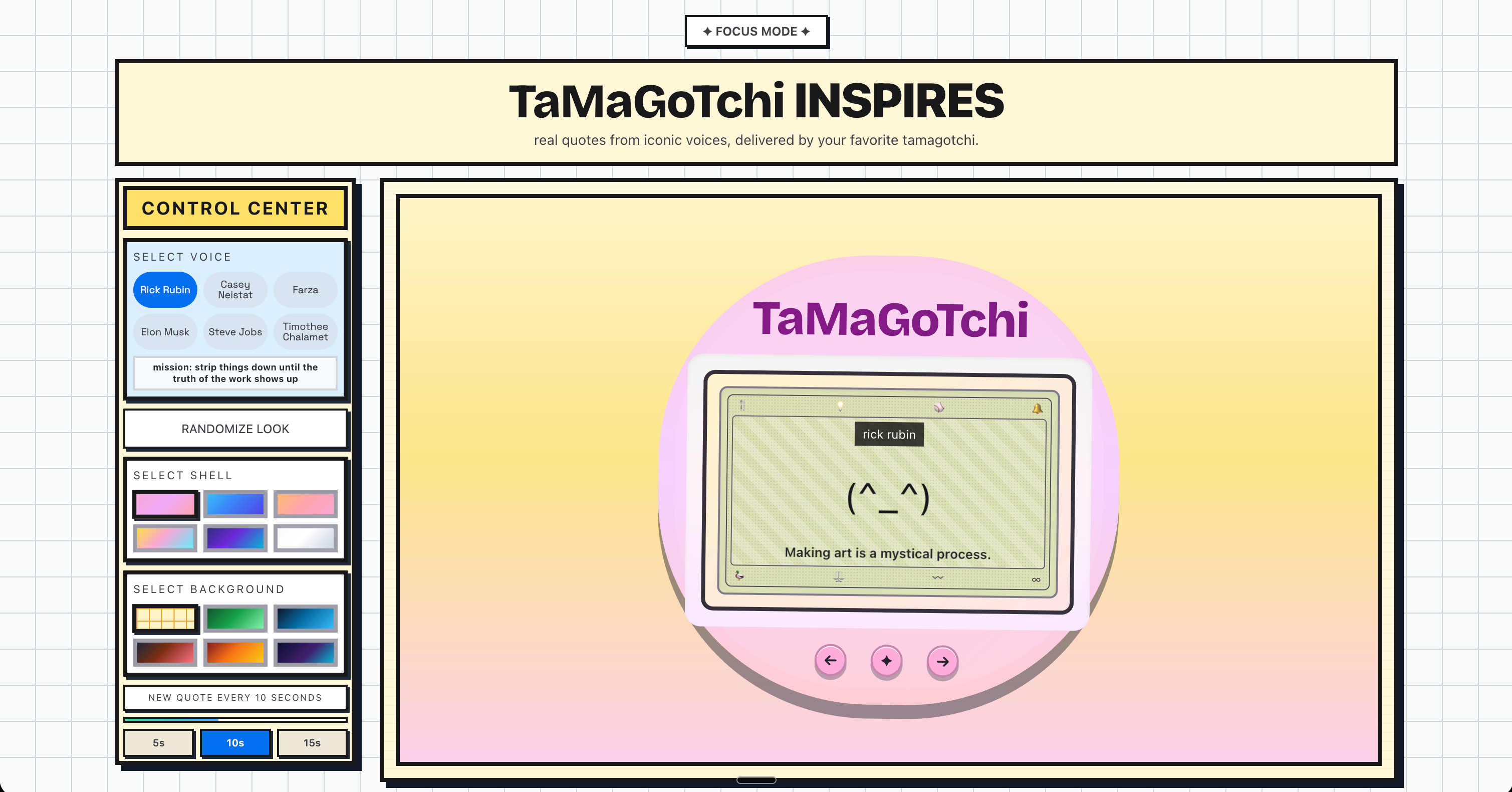
Between v1 and v2, something shifted. I stopped thinking like someone building a thing and started thinking like someone who actually uses it. Which, in this case, I am. The Tamagotchi now lives on my desktop while I code. I look at it often.
And as that user, the list of things that felt wrong was immediate and obvious:
I didn’t want to scroll, everything should live on one screen.
The buttons needed to feel interactive, not just functional.
I wanted to control the refresh rate myself instead of being stuck at 12 seconds.
I wanted the back and forward buttons to move through quotes in order, not randomly (sometimes I copy and paste the quotes to friends).
I wanted to understand why I’d pick Rick Rubin over Steve Jobs before I had to choose.
I wanted a focus mode - everything stripped away, full screen, just the Tamagotchi.
None of that came from a research phase. No PRD, no user interviews. It came from using the thing and feeling what was off.
That’s what this whole iteration taught me about taste in practice. You don’t surface it by reading about design. You surface it by using something you made and paying attention to the friction.
The first version doesn’t create enough friction to feel that. It just needs to exist. The second version is where the friction starts talking.
You need the agency to actually go back. Shipping v1 is one kind of courage. Returning to it, deciding it deserves more, and rebuilding it because you think it should be better - that’s a different kind. Nobody asked me to do v2. No metric justified the sprint. I just knew it wasn’t done.
The gap between idea and artifact is so small right now that you can feel your way into a product instead of planning your way into one. When building was expensive, you had to specify everything upfront because iteration cost too much. Now it doesn’t. Which means your taste can show up in real time, grounded in actual use instead of speculation.
First version: does it exist?
Second version: does it deserve to?
TaMaGoTchi Inspires v2 is live. It’s not a startup. Maybe a few friends use it. But it’s finally the thing I actually imagined when I had the idea, not just the version I could ship in 60 minutes. That’s a different bar, and I couldn’t have cleared it without clearing the first one.
Try v2: here
If you haven’t shipped anything yet, that’s your v1 waiting. If you have, you already know what needs fixing.
— Akash