


read time 6 minutes
My job is building products at scale.
At Walmart, I worked on search and personalization - the kind of system where a single bad decision affects millions of people looking for something at 11pm. At Adobe, I’m building AI agents for enterprise marketers, coordinating across engineering teams, infrastructure, compliance, and customers whose entire data operations run on the platform.
I know how software gets made. I live in that world every day. Yet, I had never shipped something just for myself. No PRD, no stakeholders, no users to research. Just me, an idea, and a question I’d been avoiding: what would I actually build for fun if I could build anything?
That question sat unanswered for a while because everything I imagined building felt too small to justify the effort. I was used to shipping things that mattered at scale. What’s the point of a tiny app that a hundred people might use?
This weekend I figured out that was the wrong question entirely.
I joined a live session run by Farza - a sharp builder and thinker whose whole mission right now is simple: get people to make something, ship it, see what happens. The event was called makesomething. The premise was even simpler: build an app in 60 minutes, put it on the internet, done.
I showed up thinking this would be a forcing function. I know how these systems work and I’ve used AI prototyping tools before. What I didn’t expect was who else was in the room.
The YouTube chat was full of people from Canada, India, Brazil, Netherlands, all over - many of whom had never opened a code editor. Questions like “what’s localhost:3000” and “what’s git?” were flying by in real time. Farza and his co-host Julian were answering them without condescension, like this was exactly the right place to ask.
Something shifted in me when I saw that. I work in an environment where I’m usually the person who understands the system. Here, I made a deliberate choice: treat this like a beginner - don’t try to build the smartest thing or the most useful thing, build the thing you actually want to see exist.
The tool the session uses is Codex - an AI coding agent from OpenAI. You describe what you want in plain English, it writes the code, you watch it come alive in your browser. No syntax to memorize. No stack decisions to make upfront.
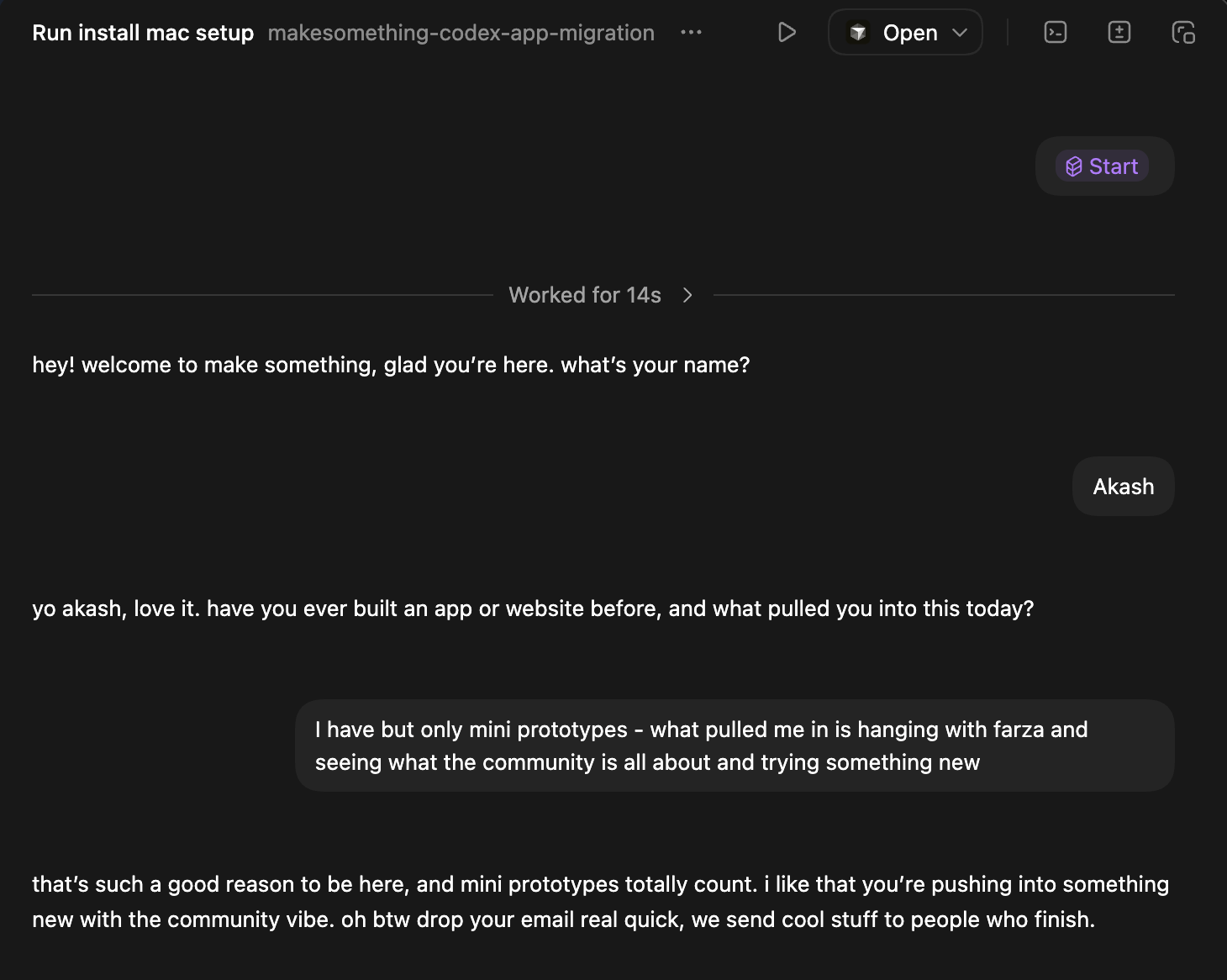
$start command in terminalOnce setup was done, it asked me a surprisingly human question: what are you into these days, like what do you spend your time on?
So I answered honestly without thinking much. I’ve been obsessed with analog things lately because the digital world is exhausting. I bought Tamagotchis for me and a few friends - grown adults, completely losing it over a pixelated egg. At the same time, I’ve been deep in Rick Rubin’s The Creative Act, quoting it constantly. His whole philosophy, strip things down until the truth shows up, has been running in the background of how I think.
Codex asked. I answered. And somewhere in that answer, an idea showed up:
What if those two things were one thing?

TaMaGoTchi Inspires is exactly what it sounds like. A giant retro Tamagotchi on a webpage. You pick a shell color. You pick a voice: Rick Rubin, Casey Neistat, Farza, Elon Musk, Steve Jobs. You tap the device and it drops a line of wisdom in that person’s tone. It auto-refreshes every 12 seconds. Left button goes back. Right button goes forward. Center button sparks something new.
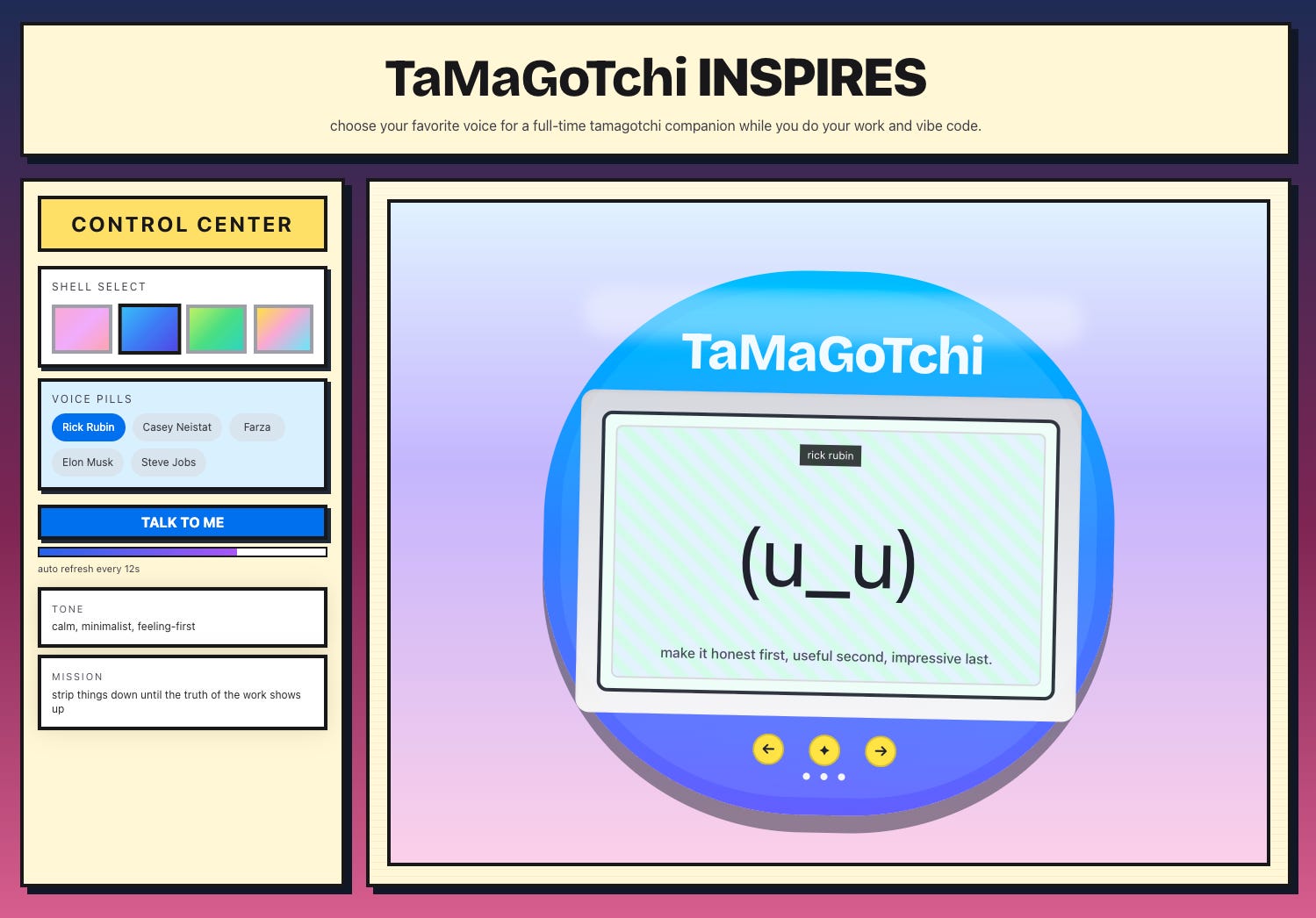
I downloaded Tamagotchi images from Google to give Codex visual references. I pulled examples from arcade-y websites I liked. Then I just kept prompting until the look and feel matched what I had in mind:
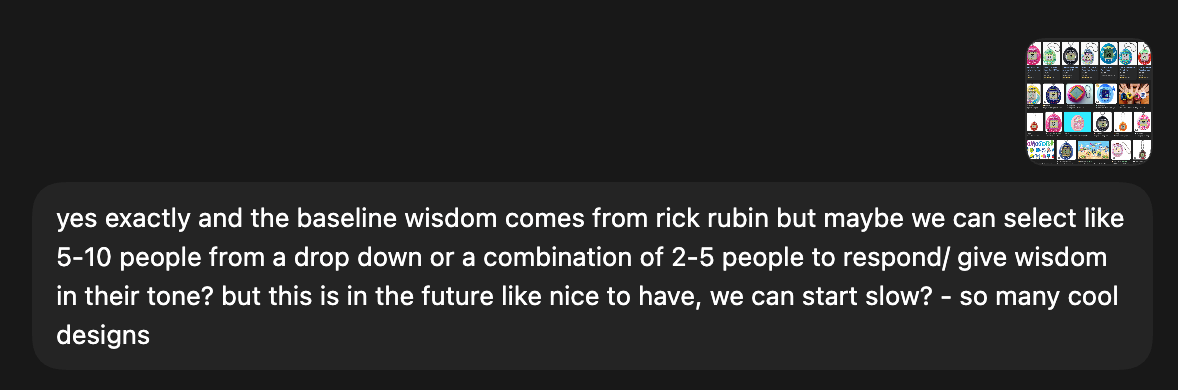
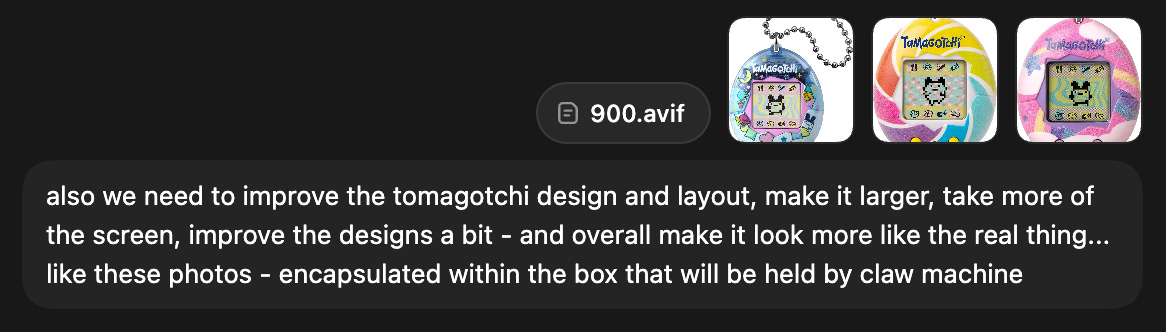
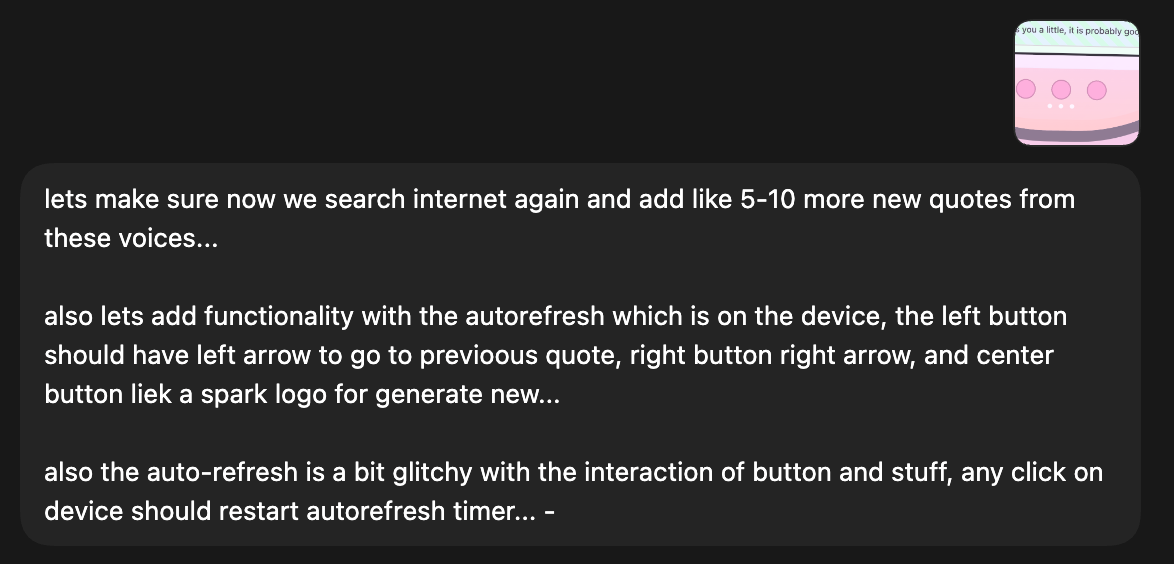
Each prompt executed in under 5 minutes. At the 60-minute mark, I typed $deploy. Codex pushed it to Vercel. A real URL appeared. The app was on the internet.
Here’s what I want to talk about because this is the part nobody writes about when they write about vibe coding: the whole session felt like an arts and crafts class.
In the best possible way - there was no critique, nowhere to be, no stakeholder asking why this Tamagotchi needed to exist. No alignment meeting. No metric to justify the build. Just a room full of people making small weird things because they wanted to see them come alive.
For decades, software building felt serious because the cost of building was high. AI tools are quietly making experimentation playful again.
We need more of that. Spaces where the output doesn’t have to justify itself. Where the act of making is enough.
I’ve been noticing that the best creative moments in my life have always had this quality - a constraint on time, an absence of pressure, and permission to just try something. The arts and crafts class. The side conversation at a hackathon. The sketch you do on a napkin because there’s nothing at stake.
Vibe coding, in that environment, felt like that.
Now, let’s talk about ‘having good taste’. Because every builder, AI writer, and online guru right now is saying taste is the most important thing in the AI era. And I want to be direct: most of them are using it as a placeholder for something they can’t quite explain.
So let me actually say what it meant in this session.
The reason my Tamagotchi turned out the way it did wasn’t because I have superior aesthetic judgment. It’s because I grew up in the 90s and remember what those devices felt like. It’s because I bought one as an adult and noticed the specific feeling of holding a thing that only does one thing. It’s because I’ve been quoting Rubin long enough that his voice is somewhere in my head.
That’s not taste in the abstract. That’s lived preference. The specific imprint of experiences you’ve actually had.
My mother’s cooking tastes like home not because the recipe is objectively good, but because of everything attached to it. That’s what taste is. It’s not a skill you develop by reading essays about aesthetics. It’s what accumulates when you pay attention to the things you love (and the things others love too).
That’s what I was drawing on when I described what I wanted to Codex.
Here’s the realization that took me by surprise.
I’ve spent three years thinking my first shipped app needed to clear some bar - useful enough, polished enough, worth enough. Product managers spend years building that instinct. Does this move the metric? Does this justify the sprint?
But that calculus only makes sense when you’re building for millions of people. When you’re building for yourself, the bar is different. The bar is simply: does it exist?
If that sounds obvious, it wasn’t obvious to me. The habits of building at scale - the PRD, the research phase, the alignment - are genuinely useful at scale and genuinely in the way when you’re just making something because you want to see it.
Farza’s advice was simple: build for yourself first. Don’t worry about users yet. If you actually want to use it, you already understand the experience. You don’t need a research phase.
That single shift made shipping possible in 60 minutes.
The biggest thing I came away with isn’t about Codex or AI or building in public. It’s about the gap between the kind of building I do professionally and the kind that was always available to me personally. I had permission to start long before last weekend. I just never gave it to myself.
My new goal is to publish one vibe-coded project per week. 52 things in a year. Some will be dumb, some might become useful, but all of them will exist in a way that the ideas sitting in my notes app do not.
The distance between an idea and a real thing on the internet isn’t years. Sometimes it’s just 60 minutes and a willingness to treat the whole process like arts and crafts.
P.S. The app is live for those of you who want to play with it: TaMaGoTchi inspires
(3/8/26 11:56pm) Built a v2 w/ new features: https://tomagotchiinspires.vercel.app/
— Akash