


read time 5 minutes
I wasn’t expecting to feel anything. I was just organizing old files.
Then I opened a document from 2014. I was 15. It was a speech I’d written to run for VP of my school student council. Short, confident, slightly ridiculous. I wrote: “I’m annoying - which means I won’t give up on your demands no matter how many times we are rejected.”
I laughed. Then I sat with it a moment longer than I expected to, because that sentence felt more like me than a lot of things I’ve published in the last year.
I’ve spent the last week going back through everything I wrote before AI existed in my life. School debate speeches, university applications, cover letters from my first job hunt, a research paper I co-authored with my professor at Chapman on the symbolic nature of price, and essays from a course I took called Humanomics that I never stopped thinking about.
The oldest piece is from 2014 and the most recent is from late 2022, just before AI changed things.
What I noticed is that my voice got clearer over those eight years. I was writing constantly and paying attention to what felt true versus what felt performed. Sentence by sentence, year by year, I was becoming a writer… I just didn’t know it.
This is the speech (from 15 year old Akash):
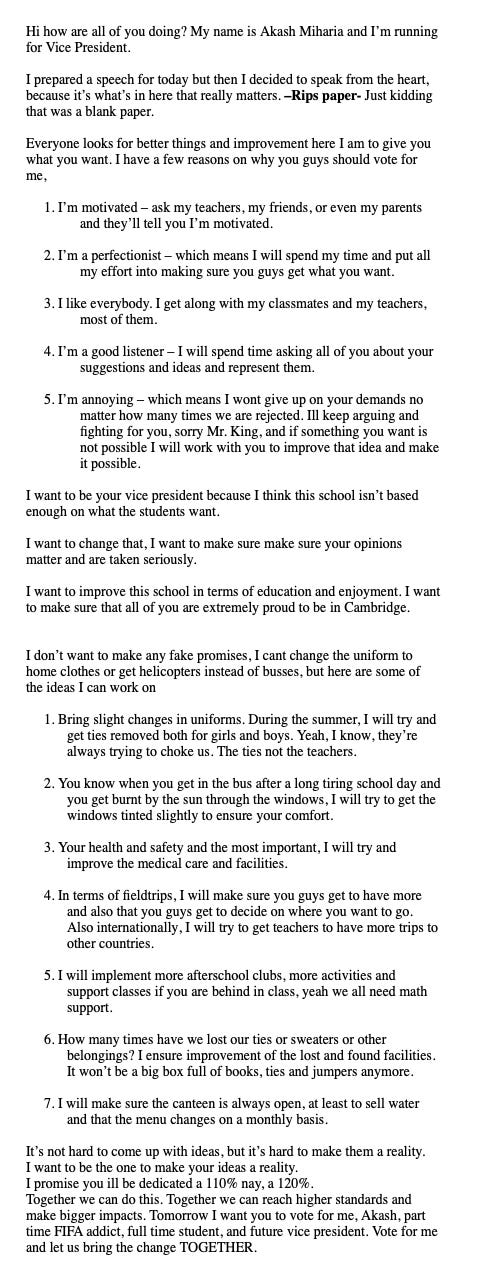

In 2017, I made a short film about construction workers in Abu Dhabi. I wanted to capture what the city’s skyline doesn’t show - the labor underneath it. In my university application essay, I wrote about the experience: “Making this video was not easy. The exposure was off and there was no way to drown out the unglamorous truth of our home.”
I couldn’t solve the technical problem so I made something that lived inside it instead. That was a writing instinct, and it was mine before anyone taught me to have it.
A year later, I took a course at Chapman called Humanomics - the intersection of economics, humanities, and human behavior. The opening question of the course: What makes a rich nation rich and a good person good? I thought I knew walking in. I was wrong. By the end, I had written something I still believe: “People make a nation rich and a united nation makes its people good. I must continue to strive to be atypical.”
Clunky sentence, but a true idea - shoutout early Akash.
Then came the research fellowship at Chapman’s Economic Science Institute - a deep dive into a question that had been forming for years: are prices like words? Both carry symbolic meaning. Both are interpretations of value. Both require someone to bring something to them in order to mean anything at all. I wrote: “To buy a good for the right price is like choosing the right word; it is a personal process of aligning theory with reality, of creating meaning out of perception.”
That project became a published paper. But more than that, it became a way of seeing. The way of seeing became a newsletter. And the newsletter became the question I’m still sitting with:
How do humans make meaning inside systems that increasingly make meaning for them?
I didn’t plan that arc, I only see it now by going back.
Here’s the thing nobody tells you about writing with AI: you don’t lose your voice all at once. You lose it the way you lose a tan, so gradually that you don’t notice until you see a photo from before.
First you use AI to polish a draft, then to structure one, then to start one. One day you’re reading something that sounds like you — same topics, similar rhythm — but something is off. Like a cover version where the notes are right but the phrasing is someone else’s. Slowly, you stop discovering your voice and start supervising it.
I didn’t realize this was happening to me until I read what I used to write. The VP speech from 2014 didn’t have any signposting. No “here’s what I’ll argue” or “the key insight is.” It just said what it had to say and trusted you to follow. The Humanomics essay didn’t use a single bullet point. It moved through ideas the way a conversation does → associatively. Chasing what was interesting rather than what was efficient. The Language of Price paper opened with a rabbit hole and ended with a Lewis Carroll quote about a new idea being “a pleasure very near to sadness, bringing tears to one’s eyes like a beautiful picture or poem.”
None of that is optimized for clarity alone. All of it is unmistakably mine.
There’s a kind of AI hallucination nobody’s building safeguards for, the one where the model learns your patterns and starts generating a flattened version of you. It brings your voice to baseline, an average. Same vocabulary, similar structure, but the rough edges that made it interesting are sanded off. You don’t notice because the output is good. It’s just not yours anymore.
The only defense I’ve found is going back to the source material. Not to replicate it… I’m not trying to write like a 15-year-old again (though that kid had better instincts than he knew). But to remember what it felt like to write before I started asking "is this clear enough?" Clear to who?
Your old writing is your golden training data - the unaugmented version of you. The proof that a voice existed before anyone offered to improve it.
If AI is becoming a creative collaborator, then identity is becoming an interface problem. We have tools that remember everything we’ve ever asked a model to generate, but almost nothing that preserves who we were before optimization entered the loop.
I’ve been thinking about this phrase, golden training data, because it captures something I don’t hear people talking about yet. We spend so much energy curating our inputs: the right prompts, the right tools, the right workflows. But the most valuable dataset I’ve found isn’t something I downloaded or engineered. It’s a folder of Word documents from 2014 to 2022, written by someone who didn’t know he was building a voice, one draft at a time.
That folder is now the foundation of everything I’m building with Product Rookies, a newsletter about how humans make meaning inside the systems we create. The through-line from that 15-year-old’s student council speech to this essay you’re reading is not strategy. It’s just a person who kept writing, kept paying attention, and got lucky enough to look back before he forgot what his own voice sounded like.
I’d recommend the exercise. Go find yours before optimization convinces you it never existed.
— Akash